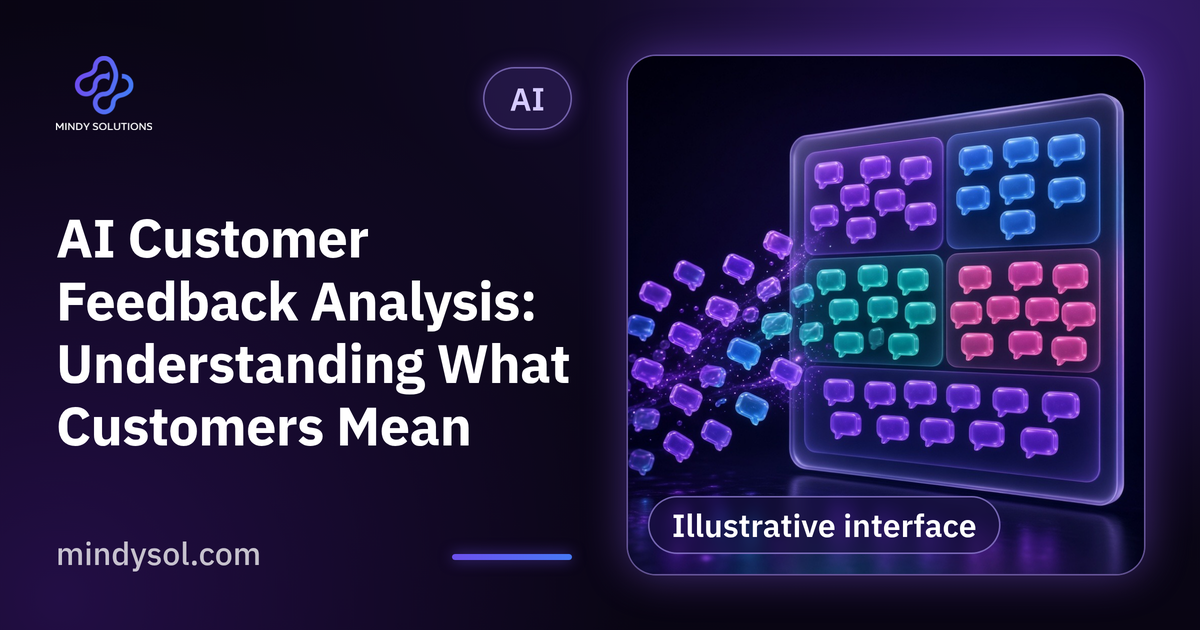
Customers tell you a lot about their experience: in social media comments, messages, surveys, support conversations and direct conversations with your team. But this feedback is scattered, plentiful and written in many styles, making it hard to read everything and see the whole picture. Companies end up reacting to the latest comment or the loudest voice instead of the themes that genuinely recur. AI can help gather, categorize and summarize feedback so your team understands what customers mean and decides what to improve. At Mindy Solutions, here's a practical approach from our experience.
Why feedback matters
Feedback is a direct window into customer experience: what they like, what frustrates them and what they wish for. It reveals things sales numbers don't, such as why customers hesitate, a confusing ordering step or an unmet expectation. Its value appears only when read systematically.
The challenge
Volume
Too many comments and messages to read.
Fragmentation
Each channel lives somewhere different.
Language and style
Arabic, dialects, English and abbreviations.
Ambiguity
The same issue described in different words.
Selective memory
Teams remember sharp comments and forget quiet recurring ones.
Step one: gather feedback in one place
Identify sources such as surveys, comments, support messages, call summaries and field team notes. Collect them regularly into one place with basic context: date, channel and related product or service. When feedback links to the customer record in a CRM, it can be connected to customer type and history.
Step two: categorize
AI reads each item and assigns a topic such as product quality, delivery, support, website usability or communication, plus a general tone: positive, negative, neutral or suggestion.
Start with clear categories
Topics you know from experience.
Allow new themes
AI may surface something unexpected.
Review a sample manually
Confirm accuracy.
Refine categories
As your understanding grows.
Step three: understand recurring themes
After categorizing, the picture emerges: which themes recur, which are growing and whether feedback about one product differs from others. AI can summarize each theme clearly with real examples. Summaries give the idea; examples convey customers' actual words. Remove personal details when sharing examples internally.
Step four: from understanding to decisions
Analysis has no value without action. After each cycle, the team discusses which themes deserve action, who owns them and what the next step is, then checks next cycle whether feedback on that theme changed.
Set priorities
Not every comment needs immediate action.
Assign owners
So themes don't get lost between departments.
Track the effect
Watch feedback after changes.
Close the loop
Tell customers when you improve something they asked for.
Read results carefully
AI can misread sarcasm, dialects or context; a comment praising "amazing delivery speed" might be sincere or sarcastic. Review samples regularly and don't rely on automatic categorization for sensitive decisions without reading the original feedback. Remember too that feedback comes from customers who chose to write, who may not represent everyone.
Positive feedback matters too
Positive feedback shows what customers genuinely value, helping you protect strengths, giving marketing real language about what matters to customers and recognizing your team's effort.
Sharing with departments
Each department needs a different part of the picture: product teams care about quality, operations about delivery, support about communication and web teams about usability. Instead of one long report, prepare a focused summary for each department with relevant themes and customer examples, so feedback reaches the people who can act on it.
Cleaning feedback before analysis
Before categorizing, remove duplicates, split items covering several topics and drop names and details that don't help analysis. Decide who on the team returns to original feedback when needed.
Regular rather than occasional analysis
Real value comes from consistency: a monthly or quarterly analysis done the same way lets you compare and see change. A short summary of top themes, changes from the previous cycle and decisions taken goes to management and relevant departments.
Common mistakes
Analyzing one channel only
An incomplete picture.
Relying entirely on automatic labels
Context and dialect errors.
Analysis without decisions
Reports read and forgotten.
Ignoring positive feedback
Losing sight of strengths.
Analyzing uncleaned feedback
Duplicates and mixed topics.
Getting started
Identify sources
Where does feedback come from?
Collect for a set period
Such as the last quarter.
Categorize and review a sample
Confirm accuracy.
Discuss with the team
Agree on next steps.
Repeat regularly
Track the effect.
Feedback analysis with Mindy Solutions
At Mindy Solutions we help companies understand customer feedback: gathering it from different channels, building AI categorization and summarization tools that understand Arabic and dialects, and producing regular reports that support team decisions, with human review in every cycle. We start by understanding your feedback sources and how you handle them today, then suggest a first step together. More details are on the solutions page of our website.
Frequently asked questions
Does AI understand dialects?
It can be configured to, with sample reviews to confirm.
Does it replace reading feedback?
No. It organizes and summarizes; direct reading still matters for decisions.
Where should I collect feedback?
Surveys, comments, messages, support conversations and team notes.
When should I analyze?
On a consistent schedule so you can compare.
Should I analyze positive feedback?
Yes. It reveals strengths worth protecting.
---
Our team specializes in these services. Get in touch so we can understand your business needs and suggest the right next step.
Our team specializes in these services. Get in touch so we can understand your business needs and suggest the right next step.
💬 Contact us