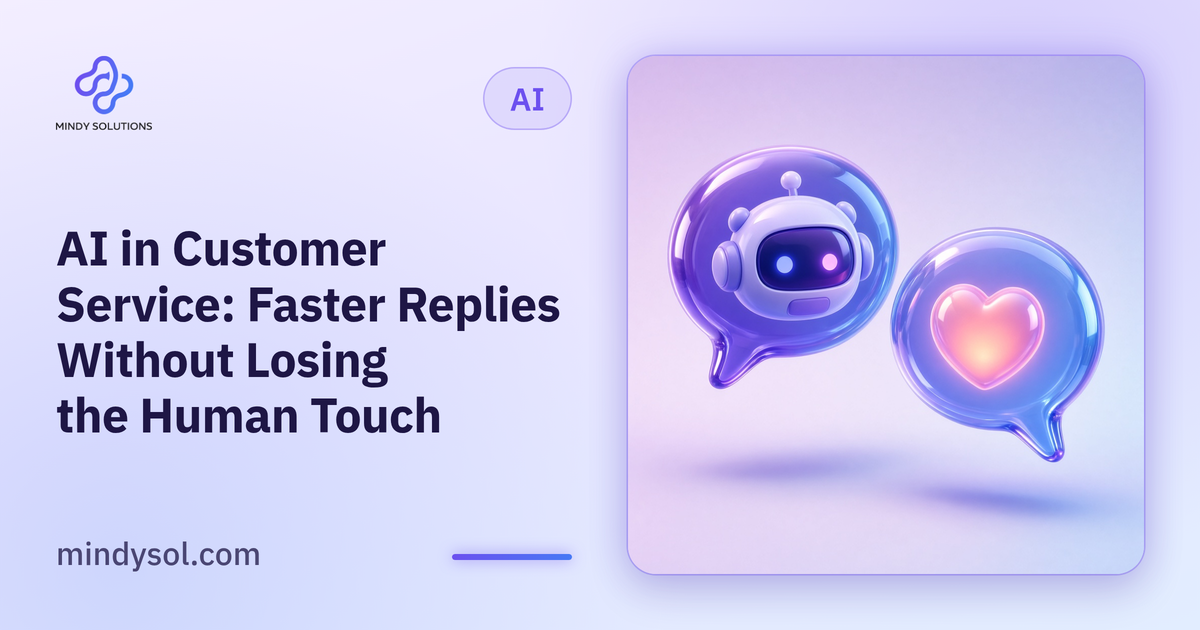
Customers expect fast replies at any hour on any channel, while service teams are limited and repetitive questions eat a large share of their day. AI looks like an attractive answer: instant responses, round-the-clock availability and less pressure on the team. But there's an understandable worry: will customers feel they're talking to a machine that doesn't understand them? Will you lose the warmth that sets your service apart? At Mindy Solutions we've outlined how to use AI customer service to speed up replies while keeping the human touch where it matters.
What AI can do
Answer recurring questions
Opening hours, location, how to order, general service details.
Understand and route requests
Read a message, identify its topic and send it to the right team or person.
Gather initial information
Ask for key details before a staff member takes over.
Assist staff
Suggest replies or summarize long conversations for a person to review and edit.
Organize requests
Tag messages by topic and priority so nothing important gets lost.
When a business chatbot fits
A chatbot fits when many similar questions arrive and their answers are clear and fairly stable. Customers get instant answers, and the team is freed for cases needing thought and a personal approach.
It also helps outside working hours. Instead of silence until morning, the customer gets an answer to a simple question, or at least confirmation the message was received, with the details collected so the team can follow up quickly.
When a person must step in
The customer is upset
They need someone to listen, not a canned answer.
The issue is complex or unusual
Outside the known questions.
The decision needs authority
Exceptions and special cases.
The customer asks for a person
A clear request that should be honored immediately.
The bot doesn't understand
After one or two tries, a handoff beats going in circles.
Smooth handoffs
The worst experience is explaining a problem to a bot, then being transferred to someone who asks you to start over. A good handoff passes the whole conversation with a clear summary so the agent picks up where the bot left off.
Customers should also know when they're talking to an automated system and when to a person. Transparency builds trust, and customers who know there's a clear route to a human are more comfortable using the bot for simple things.
Keeping your company's voice
AI can be tuned to sound like your company: formal or friendly, brief or detailed, standard Arabic, English or a familiar dialect. Tuning takes time and review but makes a real difference.
Above all, the information it relies on must be accurate and current. If hours or service details change, update its sources immediately. A fast wrong answer is worse than a slow right one.
Mistakes to avoid
Hiding the route to a person
Customers feel trapped.
Letting the bot improvise
It should rely on approved information and admit when it doesn't know.
Skipping reviews
Conversations need regular review to catch poorly answered questions.
Launching everything at once
Start with a defined scope and expand.
Forgetting the team
Staff need to understand the system and how handoffs reach them.
Continuous review and improvement
AI customer service isn't finished at launch. Real conversations reveal unexpected questions, phrasings the system misread and moments where handoffs should be faster. Regular review of sample conversations, combined with team notes, improves answers, fills gaps and tunes handoff rules, bringing the system closer to how your company actually serves people.
The team's role after AI arrives
Introducing AI doesn't diminish the service team; it changes their work. Instead of answering the same question many times a day, people focus on cases needing judgment and empathy. They also become partners in improving the system, spotting new questions and flagging unsuitable replies. Involve them from the start and explain the goal so they see the system as a helper, not a replacement.
Getting started
Collect recurring questions
Review past messages and pick the most frequent.
Prepare approved answers
In your voice, accurate and up to date.
Define handoff rules
When and how a customer reaches a person.
Start on one channel
Test before expanding.
Review and refine
Regularly check conversations and update answers.
AI solutions from Mindy Solutions
At Mindy Solutions we help businesses build AI and automation solutions that fit how they work, including chat assistants that answer recurring questions, gather initial details and hand conversations to staff with a clear summary when needed. We start by understanding your customers' questions and how you like to serve them, so the solution feels like an extension of your voice. More details are on the solutions page of our website.
Frequently asked questions
Will a chatbot replace the service team?
No. It handles simple, recurring questions so the team can focus on cases that need a person.
Can it understand local dialects?
It can be tuned to understand varied phrasing and reply in a familiar style, with ongoing review.
What if the bot doesn't know the answer?
It should say so clearly and hand over to a person or log the request for follow-up.
Should customers be told they're talking to an automated system?
Yes. Transparency builds trust and tells them when they can ask for a person.
Does it work outside business hours?
Yes, that's one of its main benefits, with clarity on when the team will follow up.
Where do we start if our questions vary a lot?
Begin with the most frequent questions only and expand after reviewing conversations.
---
Our team specializes in these services. Get in touch so we can understand your business needs and suggest the right next step.
Our team specializes in these services. Get in touch so we can understand your business needs and suggest the right next step.
💬 Contact us