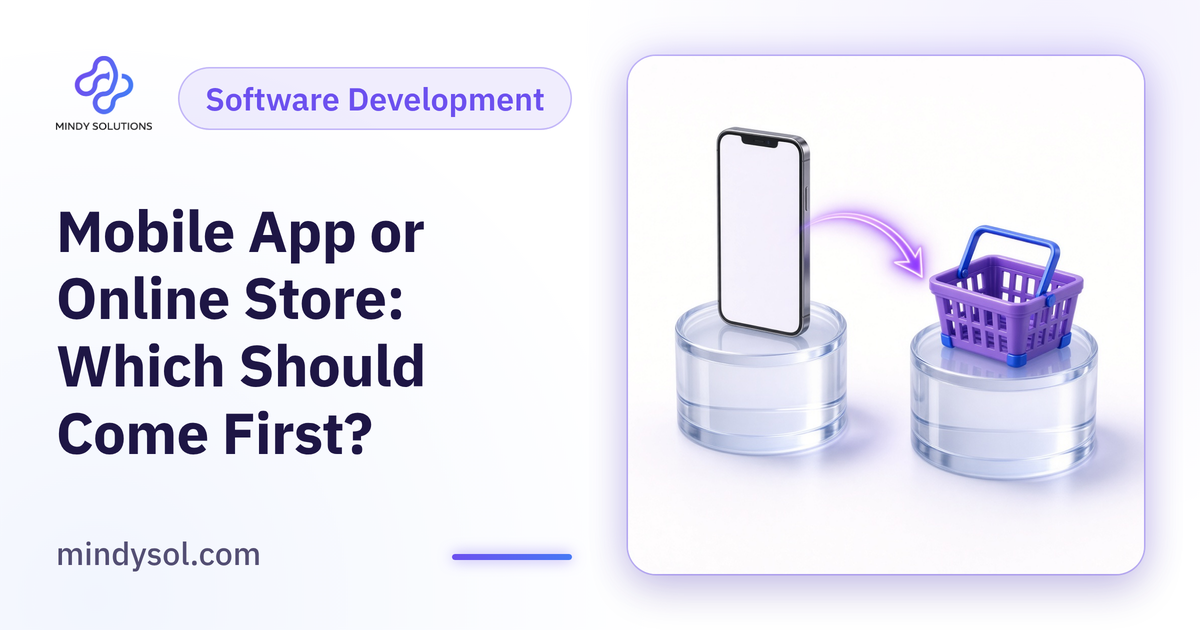
Once a business decides to sell online, the same question tends to come up: start with an online store, or build a mobile app? Some have heard apps are the future and want to jump straight in. Others think a store is enough and an app is never needed. The real answer depends on your business, your customers and your stage. At Mindy Solutions we've compared the two options practically, so you can see when a store is the better starting point, when an app deserves to come first or soon after, and which questions settle the decision.
The core difference
An online store is a website customers open in any browser, on a phone or computer, with nothing to install. A link or a search result is all it takes to start shopping.
An app has to be downloaded from an app store first. After that, it lives on the customer's home screen, opens with a tap and can send notifications. That small difference in access shapes everything else: how customers discover you, how often they return and how much effort it takes to win them.
Advantages of starting with a store
Easy access
Anyone can reach it from a link or search, with no download. That matters for new customers who won't install an app for a shop they've never tried.
Search visibility
Store pages appear when people search for your products, a steady source of new visitors.
Faster launch
Stores are usually quicker to build and easier to adjust.
One channel for every device
A responsive store works on phones, laptops and tablets at once.
Easy sharing
Product links travel easily through messages and social platforms and open instantly.
Advantages of an app
Faster experience for regulars
Apps open quickly, remember preferences and make reordering easy.
Notifications
Updates on orders, offers and new arrivals, as long as you use them sparingly.
Home-screen presence
Your icon reminds customers of you every day.
Device features
Deeper use of camera and location, useful for some businesses.
When a store is the better start
You're new to selling online
People need to discover you and try buying first, and a store is the easiest route.
Purchases are infrequent
Customers buying furniture or appliances occasionally won't see a reason to install an app.
You rely on search and ads
A store welcomes those visitors immediately, without a download step.
Resources are limited
A store gives you a complete presence with less effort, leaving room for marketing.
When an app deserves priority
Frequent purchases
Food, groceries and everyday items benefit from fast reordering.
An existing loyal base
Customers who already know and like you are far more willing to install.
Features tied to the phone
Real-time delivery tracking, camera scanning or location-based services.
Loyalty programs
Points and rewards are clearer and easier inside an app.
Questions that settle it
How often do customers buy?
The more frequent, the stronger the case for an app.
Where do new customers come from?
If from search, ads and links, the store is your front door.
Do you have loyal regulars?
Apps serve people who know you more than they attract strangers.
Can you maintain it?
Apps need ongoing updates for different phone systems and app store upkeep.
Can you market it?
Nobody installs an app they don't know exists.
A middle path
Some modern stores can be added to a phone's home screen, open quickly and behave much like an app, with no app store download. This suits many growing businesses: it keeps the reach of search and links while giving regulars a faster experience, and it can serve as a stepping stone to a full app later if you need one.
If you decide to build both
Plan them as one system, not two projects. Customers should see the same products, prices and offers in both, with accounts and orders connected.
Usually start with the store to attract new customers and build your base, then launch the app for regulars. Keep one dashboard, one inventory and one customer database so operations don't double.
Common mistakes
Building an app before you have customers
An app nobody knows about stays uninstalled.
Neglecting the store after launching the app
New customers still arrive via links and search.
Overdoing notifications
Too many and customers switch them off or delete the app.
Forgetting maintenance
An outdated app that misbehaves damages your reputation.
Frequently asked questions
Is a store enough without an app?
For many businesses, yes, especially if it's fast and mobile-friendly. An app adds value when purchases repeat and you have a loyal base.
Does an app take more effort than a store?
Apps usually take more time and effort to build and maintain because they need continual updates. The actual scope depends on the features.
Do I need a separate app for each phone system?
Modern frameworks can produce one app that runs across systems, which often reduces effort.
How do I get customers to install the app?
Offer a clear benefit, such as easier reordering or delivery tracking, and mention it in the store, packaging and messages.
Can I turn my store into an app later?
Yes. If the store is built on an organized foundation, the same data and systems can support the app.
Where should I start if I'm unsure?
Launch a fast, responsive store and watch how customers behave. Growing repeat purchases and a loyal base signal that an app may be worth it.
---
Our team specializes in these services. Get in touch so we can understand your business needs and suggest the right next step.
Our team specializes in these services. Get in touch so we can understand your business needs and suggest the right next step.
💬 Contact us