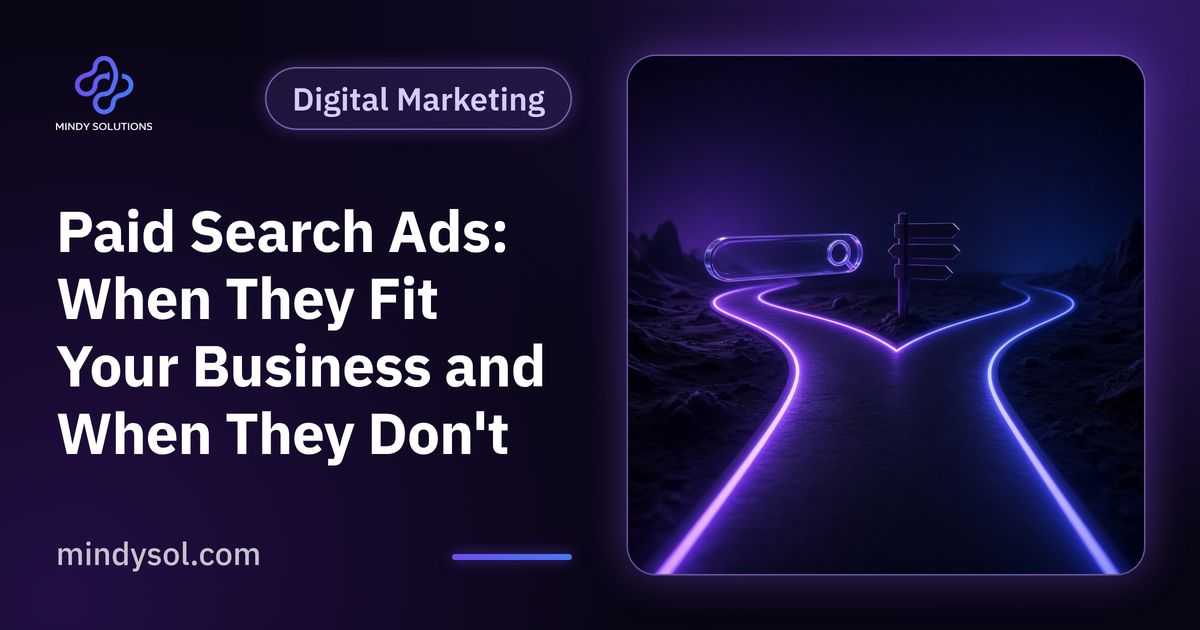
Business owners often hear that paid search is the quickest route to customers. Some launch a campaign full of hope, watch the budget disappear and wonder where the inquiries went. Paid search ads do work, but they suit some situations far better than others. At Mindy Solutions we prefer to be honest about that. This guide explains when paid search ads make sense, when another channel should come first, and what to have ready before you spend anything.
How paid search works
When someone types a query into a search engine, they see regular results and ads. The ads appear because a business chose those words, or close variations, and agreed to pay when people search with them.
The key point is timing: the ad appears at the moment of search, when the person has a question or a need. That's different from social ads, which reach people while they scroll without looking for anything in particular. It's why search ads are sometimes called intent ads.
When paid search fits
People already search for what you offer
If customers type your service or product into search engines, paid search puts you in front of them at the right moment. If your offering is new and has no familiar name yet, few people will be searching for it.
The need is urgent or specific
Emergency repairs, a near-term appointment, a contractor in a particular area. These searchers are ready to act, and an ad shortens their path.
You have a page ready to receive visitors
Ads deliver the visit; the page does the persuading. A clear, fast page with an easy way to get in touch means you're ready.
You can follow up quickly
Search leads expect a fast reply, since they've often contacted several businesses at once.
When it shouldn't come first
Your offering is unfamiliar
If people aren't searching for your idea yet, start by building awareness through content and social media, then add search ads once demand appears.
Your landing page isn't ready
Sending traffic to a slow, confusing or generic page means paying for visits that bounce.
Budget is tight and competition is fierce
In crowded categories, a small budget can run out before you learn anything useful. SEO and content may be a better starting point, alongside a very focused test campaign.
Keywords: choose with intent in mind
High-intent terms
Words that show readiness, such as a service plus a city, or terms like book and order. These sit closest to an inquiry.
Research terms
Words that suggest someone is still learning or comparing. Useful for awareness, but further from action, and they need different content.
Negative keywords
Terms you don't want to appear for, like job searches or services you don't offer. They protect your budget from irrelevant clicks.
Ad copy: clear and honest
Your ad should answer the search directly. Someone looking for a specific service in their area responds better to an ad that names that service and area than to a generic one.
Mention what genuinely sets you apart and avoid promises you can't keep. A claim the page or the service doesn't live up to costs you the customer's trust, even if it won the click.
The page behind the ad
Each ad should lead to a page that matches its promise. An ad for maintenance should open a maintenance page, not your homepage or a list of every service. Good landing pages load fast, state the service at the top, answer the basics and offer contact options in more than one spot.
Judging whether a campaign works
Clicks are just the beginning. Ask how many visits became inquiries, and how many inquiries were serious and a good fit.
Set up tracking so you know where each lead came from, and ask your sales team about lead quality. That full picture tells you whether to continue, adjust or pause.
Before you launch
Make sure you have a matching landing page for each service you advertise, a way to track leads, a team ready to respond quickly, a considered keyword list with negatives, and a test budget that gives you room to learn.
Start small, with one service in one area, learn from it, then expand gradually. It protects your budget and gives you a real understanding of your market. Set aside a regular slot each week to review the campaign: which terms brought relevant visits, which ones belong on the negative list, and which ads need fresh copy.
Frequently asked questions
Are search ads better than social ads?
Neither is better; they do different jobs. Search reaches people who are actively looking, while social builds awareness among those who aren't yet. Combining them in one plan works well.
Do I need a website to run search ads?
Yes, or at least a clear landing page. Without one, you're sending visitors to a weak experience.
Should I stop SEO once I start paid search?
No. They complement each other: ads give you quick visibility, SEO builds lasting presence.
Should I run campaigns myself or bring in specialists?
You can start on your own if you have time to learn and monitor. If search campaigns are central to your growth, a specialist team helps you avoid early mistakes and use the budget more wisely.
What are negative keywords?
Terms you exclude so your ad doesn't show for irrelevant searches, such as job hunting or services you don't offer.
---
Our team specializes in these services. Get in touch so we can understand your business needs and suggest the right next step.
Our team specializes in these services. Get in touch so we can understand your business needs and suggest the right next step.
💬 Contact us